One day - 20 September 1990 - in a think tank near you: if you're in Sydney, that is, like Susan and Erik are - those two have been working in the think tank for the better part of two years.
[so the beginning is February 1989 and the end is 24 December 1990 - this is when most of the action of A cage of butterflies by Welsh-born Australian science fiction/young adult fiction author Brian Caswell takes place - as indicated by the first chapter].
I remembered that there was a Jump! part and someone replied How high?
You would think that these people would be ... more sceptical ... especially when we consider who we are dealing with.
A man whose nefarious deeds would have me hyperventilating and perspiring on a day in late March 1996.
So here are those lines from page 78 of A cage of butterflies:
Some setting first. Eucalypts and bark and leaf-grabbing are involved; especially from Susan when she is thinking. The ground is bare; as would be expected from this think tank.
Susan - If I could just persuade him to let me inside
Forget it - Erik says - No-one goes in except the terrible twosome. How are the other researchers taking it?
SUSAN: THAT LOT? LARSEN HAS THEM WHERE HE WANTS THEM. HE SAYS ‘JUMP’, AND THEY SAY, ‘HOW HIGH’?
BESIDES HE’S ORGANISED IT PRETTY CAREFULLY.
THOSE HE COULDN’T SEND ON WILD-GOOSE ASSIGNMENTS HE GAVE A WEEK’S paid LEAVE.
THEY MUST HAVE THOUGHT IT WAS CHRISTMAS.
This is where the paragraphing and the emphasis diverge.
Here is a Queen Hammer to Fall from six years before the incident in the think-tank took place. [20 September 1984].
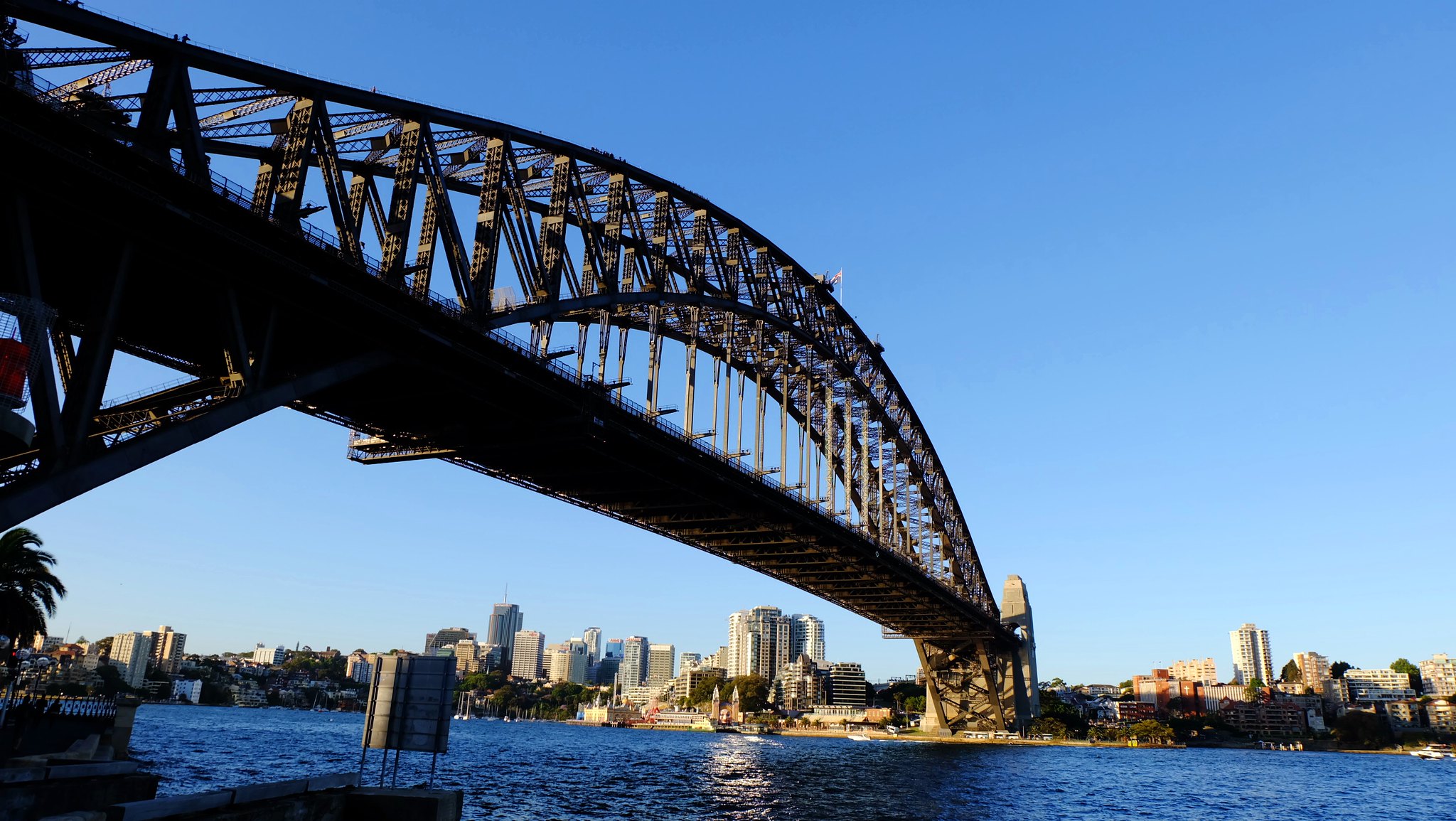
And that lot - the researchers - could jump at least as high as the Sydney Harbour Bridge by the time John Larsen is done with them.
Thank you Anna K for this illustration of the Sydney Harbour Bridge which is just right to jump and to climb.
I would quote some of the anniversary parts - the things that happened to the thinktankers and the Babies in 1989 [page 12: 21 October 1989] and 1990 [page 123: 21 October 1990] - some 30 years ago now.
Happy Grandparents' Day! Recently it has been Teachers' Day [25 October 2019] and Children's Day [24 October 2019].
And what a terrible; terrible mindset that is for a young researcher - or really, any researcher.
Here is another JUMP quote:
From high upon the cliff-top; Susan Grace tossed a small black box into the surf below and paused a moment to whisper a few words into the wind. Then she made her way back down into the waiting car; alone. [Caswell: 1992/160].
That paragraph made me think of The wind which Mariah Carey did as a cover in 1991.
And sadly there are no emoji of cages; not the literal kind nor the metaphorical kind. The closest I was able to come was a crosshatch.
All quotes are from the University of Queensland Press edition of A Cage of Butterflies.
I like what Gregory Rogers did with the cover. If you tear the butterfly from the face - you see a super large head. And the markings are very characteristic and unique.
An art project could be to capture the essence of each Baby - like I see Ian as a moth and Phetmany as a fritterary and Ricky as a spotted butterfly - maybe Monarch or Wanderer.
Myriam is the one who leads - and Rachael ...
This is a song which talks about the bond which developed - it is from Kinky Boots [Raise you up/Just be].
There is a great poem that Myriam got the youngest - Katie - to scribe.
In all the jumping; know first thyself. That's what the Delphic Oracle has to say on the matter.
3 May 2017 - horse training on a beach - the horses are in the distance.
Washed-up seaweed - 3 May 2017
The horse comes across the bend and the straight.
Mid-distance shot of the horse
Close up shot of the horse and its rider.
"Back here, horse!"
3 May 2017 - the end of the session as far as I know it
When Mardra [Sikora] and Kristi [Campbell] made their Finish the sentence Friday prompt about Pioneers; it was a really amazing thing.
This Friday [26 September 2019] I learnt that Jacques Chirac - the Mayor of Paris from 1977-95 and President of the Fifth Republic of France 1995-2007 - had died.
Chirac of course was a pioneer in so many things from local to national to global affairs. He loved his local fair with all the animals and produce. So many reactions - so many comments from everyone from Melenchon [the far-left gentleman who was in the 2017 election] to Le Pen [Marechal - she of the Front National/National Front which is very far-right and sadly popular in Bouches-du-Rhone and other southern French departements].
Macron said that Chirac represented a certain ideal of France.
I remember in particular the cohabitations of 1986 and of 1997 - the first one between Chirac and Mitterrand and the other between Jospin and Chirac. A cohabitation is when you bring different parties together in the French government.
And those moments in 2011 when it became very clear Chirac's memory was fading and failing. His years as the Mayor of Paris - and the corruption in which he may or may not have participated - were catching up with him.
How he adopted a Vietnamese woman and fostered her along with his two daughters - one of whom was not in the public eye because of body image and self-harm reasons.
On Friday too, I was writing to Science-based medicine and showing off the YouTube playlist I made about grossophobie/fat-shaming/fatphobia/fatmisia. I had made it in late July to begin with and slowly added to it since.
Our body acceptance pioneers are such important and under-rated people.
Eighteen years ago there was a big discussion of a socioeducational nature about The rising tide of mediocrity in education. This mentioned the pioneer mentality which is characteristic of so many settler societies - the USA; Canada; Australia; France; Spain; Portugal; the Netherlands; Great Britain and much of South and Central America. China and Central/West Asia also and East Asia.
How do you think and feel like a pioneer? How do you react against it and learn to live with circumstances and with others who are completely different from you?
In the early 1800s a convict called William Buckley did just this.
He lived in Western Victoria just before the gold rush and for thirty-two years he lived among Indigenous Australians from 1803-35.
Of course according to the penal colony's laws he was on the lam and law enforcement were searching for him.
Most of the time he outsmarted; outlasted; outplayed them as far as he could - and these Indigenous Australians protected him and taught him many of their ways - language; culture; country and the wisdom which comes with country.
As Rebecca has said in her pioneer quote [The limitless journey of hope and change] - how very Barack Obama by the way! [2008-2016] - pioneering is about being in a new environment and changing it and its people for the better.
In modern times - November 2015 to be exact - Ballarat jockey and trainer Michelle Payne did just that.
Many people will remember her ride in the longest race on Flemington Racecourse - and the Prince of Penzance.
She says in Ride like a girl [2019]: "I found my Prince".
Her Dad Paddy says: "Hold on to him. How many legs has he got"?
And they hug together while he is in hospital for his heart condition.
All the Paynes are around.
Some fourteen years before MJ Payne has her right frontal lobe effectively smashed as well as some head bones and she works through her rehabilitation.
The three fingers the nurse is holding up look like pink shapes - like when I am trying to read a sign from a certain distance and with certain movements or trying to read scoreboards - and she is asked questions like how to spell her name.
[Different kinds of memory: declarative; procedural; experiential/episodic; factual].
She and Paddy go through the different Melbourne Cup winners over time; especially Let's Elope from 1991 who was a very formative experience for the six-year-old [she was born in 1985; her closest brother Stephen was born a year before - we will soon learn more of him and see how he got into his dream job of strapping].
There is a scene in her school where her eldest brother races.
"Paddy came last", says Stephen.
And he does this for quite a few members of the family.
There is a great scene near the beginning where it's like we're invited to the Christmas party of the ten Paynes plus Paddy the father and the two youngest ones hide under the table and eat the pudding. We see Stevie and Shelly with the spoon. Very quiet and unnoticed they are.
One of the elder sisters lets her tongue slip. There is a very good book about the Payne family which was written by a horseracing journalist.
Many years later - we are in the 2000s here - D. Weir is in Warnamabool which is on the west coast of Victoria - and at the wedding of Cathy and McEvoy [who may have won two of the last Melbourne Cups] Michelle is trying to lose three kilograms to get ready for Sandown [south-east Melbourne].
MJ Payne does a lot of work as an apprentice.
We learn some of her and her father and brother's pioneering ways - for example; look and feel the hardest ground and use it; read the weather and see if the ground is wet or dry; walk around the track before you actually ride on it.
We also see lots of church scenes [the Paynes are Irish Catholic - and that Diocese of Ballarat has been under catastrophic strains and conditions; especially since the Royal Commission into Institutional Responses to Sexual Abuse] - some moving ones include the nuns at the totaliser/betting space and they put $148.50 on Prince of Penzance.
There is a wonderful book by one Steele Rudd [who was actually a Hoey] called On our selection which is about Dad and Dave and the farm and the other characters. It reminded me a lot of a Rodney Hall trilogy - Wandina trilogy - especially the third book which is told from the perspective of a wife who is breaking out. The first book is about a family who has been experimented on.
Also I have been reading The fortunes of Richard Mahony which I had not read since 2005 - Ultima Thule was really great and I am starting to speculate about Cuffy who is the son/grandson of Richard Mahony - and his twin siblings the Dumplings. One Dumpling dies. And Richard Mahony himself dies - but not before several chapters of agony for the family.
Mahony himself is quite the traveller and pioneer - he goes through lots of Europe like Italy and Germany and England and Ireland.
Parliament in the United Kingdom has had to be called again as of a few days ago. There have been so many insults; especially to Jo Cox and her memory. And Jeremy Corbyn - no, not one of the Jeremiad mentioned in the response - has really stuck his needles in the knitting.
Today is the #DisabilityThinking #linkup. Thank you Andrew Pulrang and everyone who contributes.
Ω Who is Mental Health Week for?
Mental Health Week is for workers. Writers. Artists. Scientists. Landscape designers. Singers. Songwriters. Theatre critics. Logisticians. Musicians. Cleaners. Cooks. Chefs. Food services personnel. Pensioners. Traders. Universal Basic Incomers. Gig economists.
It's for leaders. Managers. Executives. Activists. Advocates. Wise minds.
Mental Health Week is for followers. The people on Twitter. Facebook. WeChat. QChat. ICQ. Blogger. Google Plus. LiveJournal. VKontakt.
Mental Health Week is for psychologists. Psychiatrists. General practitioners. Specialists. Receptionists and administrative personnel.
Mental Health Week is for people in the street. Transient residents. Migrants. Refugees. Asylum seekers. Your street press vendor like The Big Issue.
Mental Health Week is for social workers. Independent living centre people. Peer supporters. Sex educators. Certified. Licensed.
Mental Health Week is for children. Teens. Tweens. Babies. The unborn and those yet to be born.
Mental Health Week is for senior citizens.
Mental Health Week is for survivors. Veterans. Travellers. Backpackers. People who have been through torture. People who have been through terrorism. People who endure through war and through peace.
Mental Health Week is for animals and plants. Service animals. Psychiatric service dogs. Trauma dogs. Hearing dogs. Guide Dogs and Seeing Eye dogs. Birds. Insects. Amoeba.
Mental Health Week is for sportspeople. Footballers. Tennis players. Mind sports people. Archers. Canoeists. Kayakers. Sailors. Rugby players. Wheelchair sports. Golfers.
Mental Health Week is for culturally and linguistically diverse people whether you speak the 800 languages and dialects of Papua New Guinea or a world language like Mandarin or Spanish or Portuguese or Arabic. It's for Africans. Melanesians. Polynesians. Micronesians. North and South Americans. Central Americans. Australians. Europeans. Asians.
Mental Health Week is for all the people who have died in the service of mental health or so that we may have life and lives.
Mental Health Week is for prisoners and criminals and those in the judicial systems. Mental Health Week is for Freudians; Jungians; Adlerians; behaviourists; cognitivists; humanists; eclectics and those whose practises come under many names and none at all. It's for the agnostics and the gnostics; the intuitives and the sensors and even the censors.
Mental Health Week is for disabled people / people with disabilities. Mental Health Week is for families. Cousins. Siblings. Great-grand-parents. Chosen families.
Mental Health Week is for friends.
Mental Health Week is for haters.
Mental Health Week is for past; present; future.
Mental Health Week is for people who are silent and people who speak out. Mental Health Week is for all the feels: grief. shame. excitement. agitation. calmness.
If Mental Health Week can not be for everybody; then it is for nobody. Mental Health Week is for you. It's for me. It's for us. It's for them. It's for they and she and he and sir and peer and ou.